The anti-moodboard method: build a brand you can defend, not just present
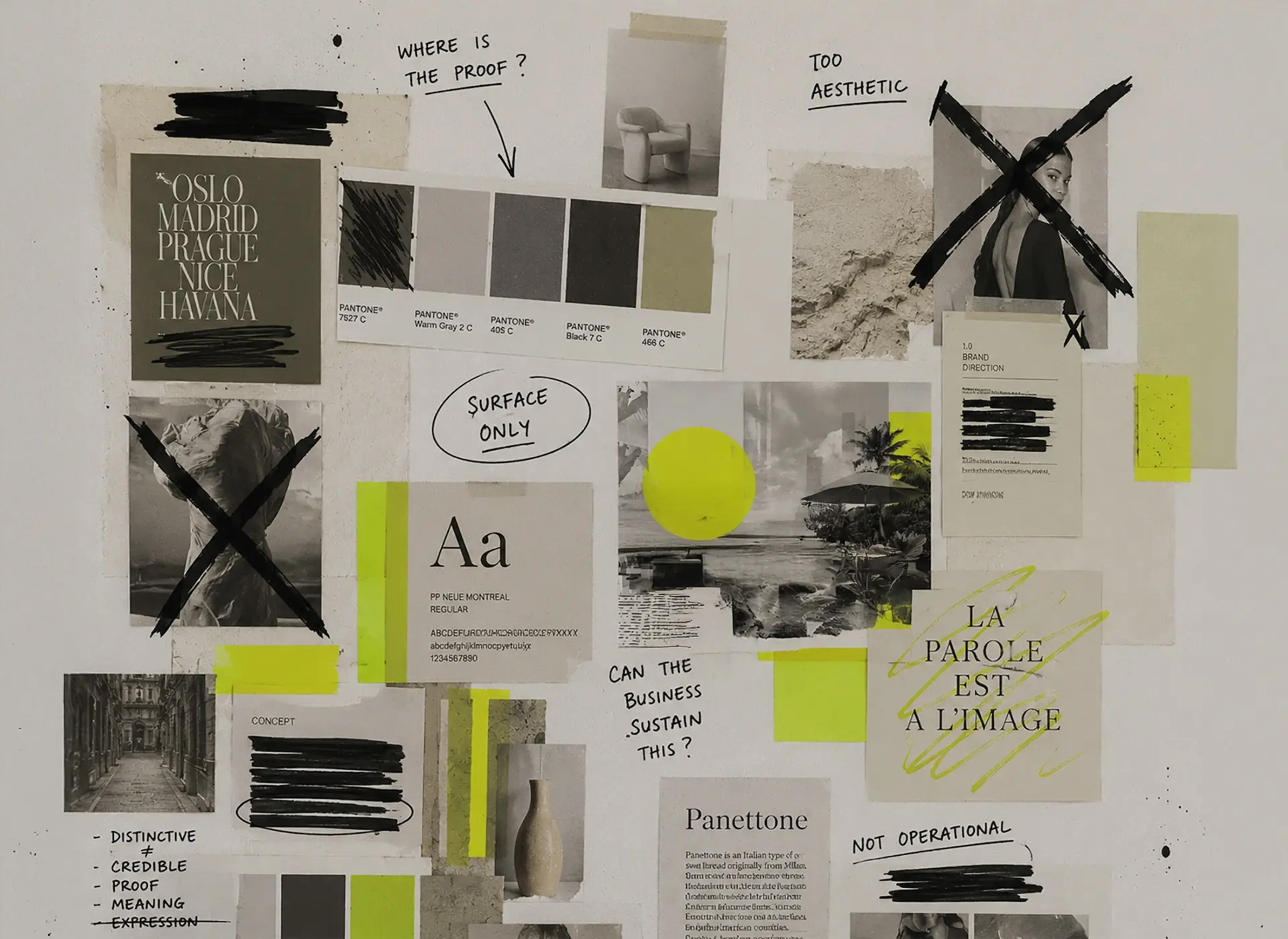
The Anti-Moodboard Method: Build A Brand You Can Defend, Not Just Present
Luxury brands are asked to do more than present well. They carry price, trust, service expectations, and future value, which means the brand has to be rooted in something the business can actually deliver. That is why we start with truth before expression.
A moodboard is used to set the tone, then language follows, identity takes shape, and campaign brings it all to life. The result is often coherent, visually resolved, and aligned with the category it sits within; but coherence is not the same as credibility.
What sits underneath is often assumed rather than defined; and in today’s luxury market, that gap is no longer overlooked, it is exposed.
Why surface is not enough
When brand work begins at the surface, it can create coherence quickly, but in luxury, surface coherence only matters if it reflects a deeper truth. Without that, the brand may present well, but it struggles to support the value being asked of it.
Branding becomes a coating: a layer applied to the business, rather than something built from it. It all looks and sounds right, but these signals are not substance.
Kantar’s research makes this distinction clear: distinctive assets account for only part of brand difference, while the greater share comes from product, service, experience, and positioning. [1]
Recognition can be designed; credibility has to be earned.
The luxury problem
Luxury is entering a period of correction.
For years, growth has been driven largely by price rather than value, placing increasing pressure on what brands are actually delivering.[2] At the same time, the customer base has contracted, and perceptions of overpricing have risen.[3]
What remains is a more selective, more exacting audience. Seventy-five percent of aspirational customers now prioritise quality above all else, while top-tier clients increasingly point to overcommunication, weak personalisation, and declining perceived quality as points of frustration.[4][5]
The shift is not subtle: luxury audiences are no longer evaluating how a brand presents, they are evaluating whether it delivers. When it doesn’t, it is quietly filtered out. The effect is rarely immediate, it happens through erosion: softer demand, weaker relevance, and a gradual loss of authority.
Roberto Cavalli offers a useful example of erosion rather than sudden collapse. Once a defining name in maximalist Italian glamour, the brand struggled through years of creative change, commercial pressure, and difficulty translating its distinctive codes into lasting contemporary relevance. By 2019, its US subsidiary had filed for liquidation and its US stores had closed. The lesson is not that bold brands cannot evolve, but that expression alone cannot protect a brand when the substance beneath it becomes unstable.
This changes the role of branding itself: from shaping perception to reinforcing reality.
Our method
The Anti-Moodboard Method is not anti-design. It is a matter of sequence.
Rather than beginning with how a brand should look or sound, we start with what it can stand behind: what is true of the business, what exists in practice rather than intention, and what can be delivered consistently over time.
From there, those truths are tested to establish what can be evidenced and repeated. Only then is meaning defined, translating those truths into something that matters to the audience, before finally moving into expression.
Truth. Proof. Meaning. Expression.
This is not a stylistic preference, but a structural one. When brands are built this way, they are more resilient, more credible, and more consistent in how they are experienced. When expression leads, the brand has to justify itself after the fact. When truth leads, expression has something to carry.
The workshop
Most differentiation is not invented; it is already there. It comes from inside the business: in how decisions are made, how standards are upheld, what makes a business unique and how details are resolved repeatedly, often without being articulated.
We use workshops because the truths that make a brand distinct are rarely held in one place. They sit across the people who build, sell, service, protect, and deliver the experience. Without that input, the brand risks becoming a polished interpretation of the business, rather than a system the business can actually use.
Research into internal branding supports this directly, showing that brand value is ultimately delivered through people and behaviour rather than messaging alone. In practice, what makes a business distinct is often embedded in how teams think, decide, and operate day to day. At the same time, studies on tacit knowledge highlight that competitive advantage often comes from experience-based insight, built through practice rather than theory.[6]
This matters because differentiation cannot be applied externally, it has to be uncovered internally. That is where distinction comes from: identifying what already exists and defining it clearly enough to matter.
On a prime residential development in central London, Trillium, the defining idea did not come from a visual territory or competitive set, but from a tension within the architecture itself; between the energy of the city and the need for calm. That balance became the foundation for everything that followed, shaping
The proof test
Every claim is tested against a simple question: can we prove it, now, not later. Not in theory, not in ambition, but in how the business actually works.
In one case, working with an architectural practice specialising in private residences and resort environments, the positioning initially relied on broad language around craftsmanship. Through the process, it was reduced to something more exact; how projects respond to place, how materials are selected, and how spaces are resolved. The language narrowed, and the brand became stronger for it.
We use proof because it protects the brand from overclaiming and gives teams confidence in what they can say. If the claim can’t be proven, it is removed. If the truth exists but the language stretches beyond it, it is rewritten. If it cannot be delivered consistently, it does not belong in the brand.
What remains is more focused, and far more credible.
When meaning comes before mood
Only once truth and proof are clear does expression begin.
At this stage, the work becomes more precise. It is no longer searching for a position, but articulating one, with tone, identity, and narrative grounded in something already defined.
In high-value residential, this often means allowing the fundamentals to lead. Architecture, materiality, location, service and scarcity give the brand its substance; the role of identity is to clarify that value, not create it from the outside. On a rare beachfront development on Marbella’s Golden Mile, for example, the role of the brand was not to elevate perception, but to support what was already exceptional: the final opportunity of its kind, where rarity and place define value more convincingly than language ever could.
In other cases, the shift is not about amplification, but reduction: removing layers until what remains feels inevitable rather than constructed.
The outcome
What this creates is a brand that remains consistent across teams, channels, and phases, because it is not dependent on campaign thinking or aesthetic trends, but anchored in something more stable.
This reduces the risk of drift, misalignment, and overstatement; issues that often emerge as brands scale.
There is strong evidence behind this. Brands that maintain long-term consistency, grounded in a clear and coherent foundation, generate stronger brand and business effects over time.[7]
Consistency alone is not the point. What matters is alignment: between what is said, what is designed, and what is delivered.
When that alignment is clear from the start, the brand does not need to assert itself because it is understood.
Why it works
In a market where scrutiny is increasing and tolerance for inconsistency is reducing, uncovering what is real and what is not becomes less of a preference and more of a requirement.
The result of an Anti Moodboard method is a brand that feels considered rather than constructed, credible under pressure, and distinctive without trying too hard.
[2] McKinsey & Company https://www.mckinsey.com/industries/retail/our-insights/state-of-luxury
[3] Bain & Company https://www.bain.com/insights/luxury-in-transition-securing-future-growth/
[5] BCG x Altagamma https://web-assets.bcg.com/51/92/68b6af8346629c05e586a734d857/bcg-altagamma-true-luxury-global-consumer-insights-report-2025-vpress-final.pdf
[6] ScienceDirect https://www.sciencedirect.com/science/article/pii/S0148296317301753
[7] IPA/System1 https://ipa.co.uk/news/creative-consistency/