Influence beyond the influencer
How creators, customers and communities are reshaping brand influence
For years, influence has been something that brands could borrow.
Find the right person, access their audience, and gain relevance through association. That model still has value, but the type of influence brands are now seeking appears to be changing.
This year, Vogue identified the rise of the ‘intellectual influencer’: a new creator class whose influence is rooted in expertise, knowledge, and insight rather than image alone.1 The significance goes beyond books becoming fashionable. It suggests a broader change in what brands want influence to provide.
Reach creates exposure, yet expertise can shape what a brand is understood to represent.
Miu Miu offers a clear example. Its Literary Club returned for a fourth edition in Milan this year, taking the work of Annie Ernaux and Ama Ata Aidoo as the starting point for three days of readings, lectures, and discussion around desire and self-determination.2
The association places the brand within a cultural conversation that has depth beyond a conventional endorsement. It also reflects a longer-term commitment rather than a single campaign moment: Miu Miu has continued to develop the Literary Club over four editions.
This doesn’t signal the end of influencer marketing – people with large, engaged audiences will continue to offer brands significant value – but what appears to be broadening is the definition of an influential voice. Knowledge, expertise, and cultural credibility are becoming part of the equation.
For hospitality, where culture and place are already embedded in the experience, that change carries particular weight.
From Hosting Culture to Contributing to it
Hotels have long brought together artists, writers, designers, and other creative voices, but some are taking a more active role in what those relationships produce.
In April, Belmond launched Writers on the Rails aboard the Venice Simplon-Orient-Express, commissioning six writers, including Bernardine Evaristo, R.F. Kuang, Ottessa Moshfegh, and David Nicholls to create original fiction inspired by journeys on the train.3 It works because storytelling already belongs to the history and mythology of the Orient-Express, allowing the commission to build on an existing association rather than importing cultural relevance from elsewhere.
Rosewood Hong Kong took a similar approach during its 2026 Art Month, describing its role as moving beyond host to ‘lead curator’, with commissioned work and cultural encounters connected to Hong Kong itself, including the interactive Lucky Dragon sculpture by Frankey.4
There is a caution here. Intellectual influence can become an aesthetic as easily as any other kind of influence, with serious subjects used to signal depth rather than contribute anything meaningful to them. Cultural programming can become borrowed prestige as readily as a conventional endorsement if there is no credible connection between the brand and the conversation it chooses to enter.
Beyond the Follower Count
The same pattern is visible across social media.
Sprout Social’s 2026 research found that only 17% of consumers check a creator’s follower count before deciding whether to engage with their content. Subject relevance and content style matter more, while recommendation-led feeds give smaller creators the potential to reach well beyond their existing audience. On Instagram Reels, for example, more than 70% of the audience a creator reaches may be people who do not already follow them.5
For brands, that places greater emphasis on fit. A creator with specialist knowledge or a close relationship with a particular community may be more valuable than a much larger account with little connection to the subject.
The role itself is developing too. Vogue reports that creators are increasingly being brought into projects earlier, contributing to strategy and product development rather than simply receiving a finished brief to promote.6 At its best, the relationship starts to look less like media placement and more like genuine creative collaboration.
Influence in More Places
The value of a creator relationship can extend far beyond an individual post. CreatorIQ found that creator-made content now accounts for an average of 44% of paid-media creative among the brands it surveyed.7
Much of that content will be seen by people who have never heard of the creator who made it. Brands are therefore drawing not only on the audience someone brings, but on their understanding of how people engage with content, what feels native to a platform, and how a message can travel beyond a single channel.
At the same time, influence is increasingly shaped by voices brands do not formally appoint at all. Customer reviews, user-generated content, employee perspectives, and niche communities all contribute to how a brand is discovered and understood. Bazaarvoice’s 2026 research found that 97% of shoppers consult multiple sources before making a purchase, suggesting that creator content is often only one part of a much wider process of discovery and validation.8
For hospitality brands, the principle travels further than the format. The implication is not necessarily to commission writers or become cultural curators, but to think more carefully about fit, continuity, and when creators enter the process. The most convincing relationships tend to have a genuine connection to the place or subject, while those developed over time can carry more weight than a single moment of association.
The result is a more fragmented, but also more revealing, influence landscape.
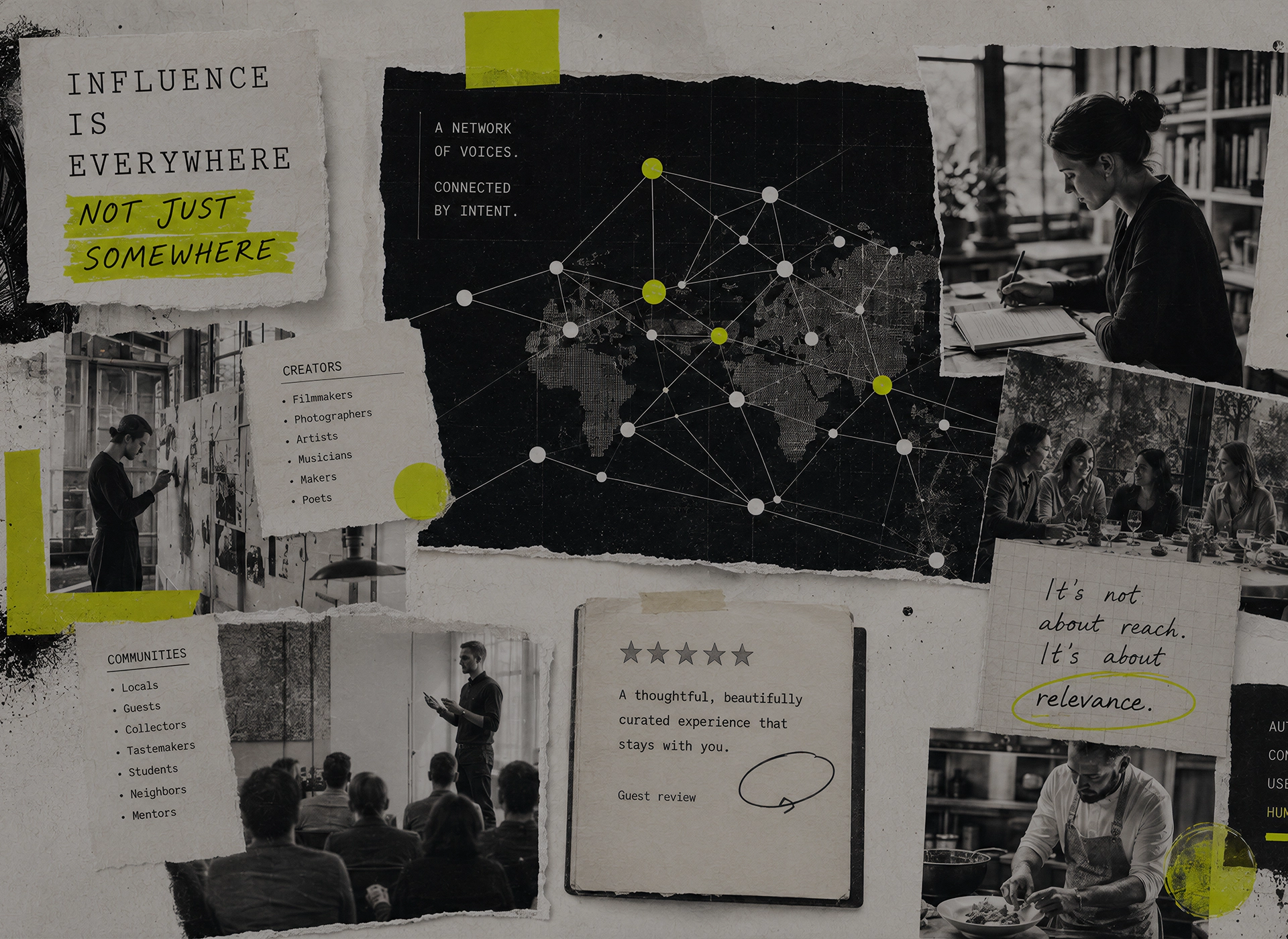
A brand might first be encountered through a creator, then validated by a customer or reinforced by someone with direct experience. Traditional influencers still matter, but they now sit within a much wider network of voices. For brands, the challenge is less about finding the biggest audience and more about understanding where influence actually sits, who carries it credibly, and what they can bring to the relationship.
Influence has grown beyond the influencer.
1Vogue – Less Internet, More Intellect: The Era of the Bookish Influencer
2Miu Miu – Miu Miu Literary Club 2026: Politics of Desire
3Belmond – Writers on the Rails
4Rosewood Hotels – Lucky Dragon: Where Heritage Meets Art as a Living Encounter
5Sprout Social – The 2026 Influencer Marketing Report
6Vogue Business – How Influencer Marketing Is Changing in 2026
7CreatorIQ – Creator-Powered Funnel Report 2026
8Bazaarvoice – Shopper Experience Index 2026